
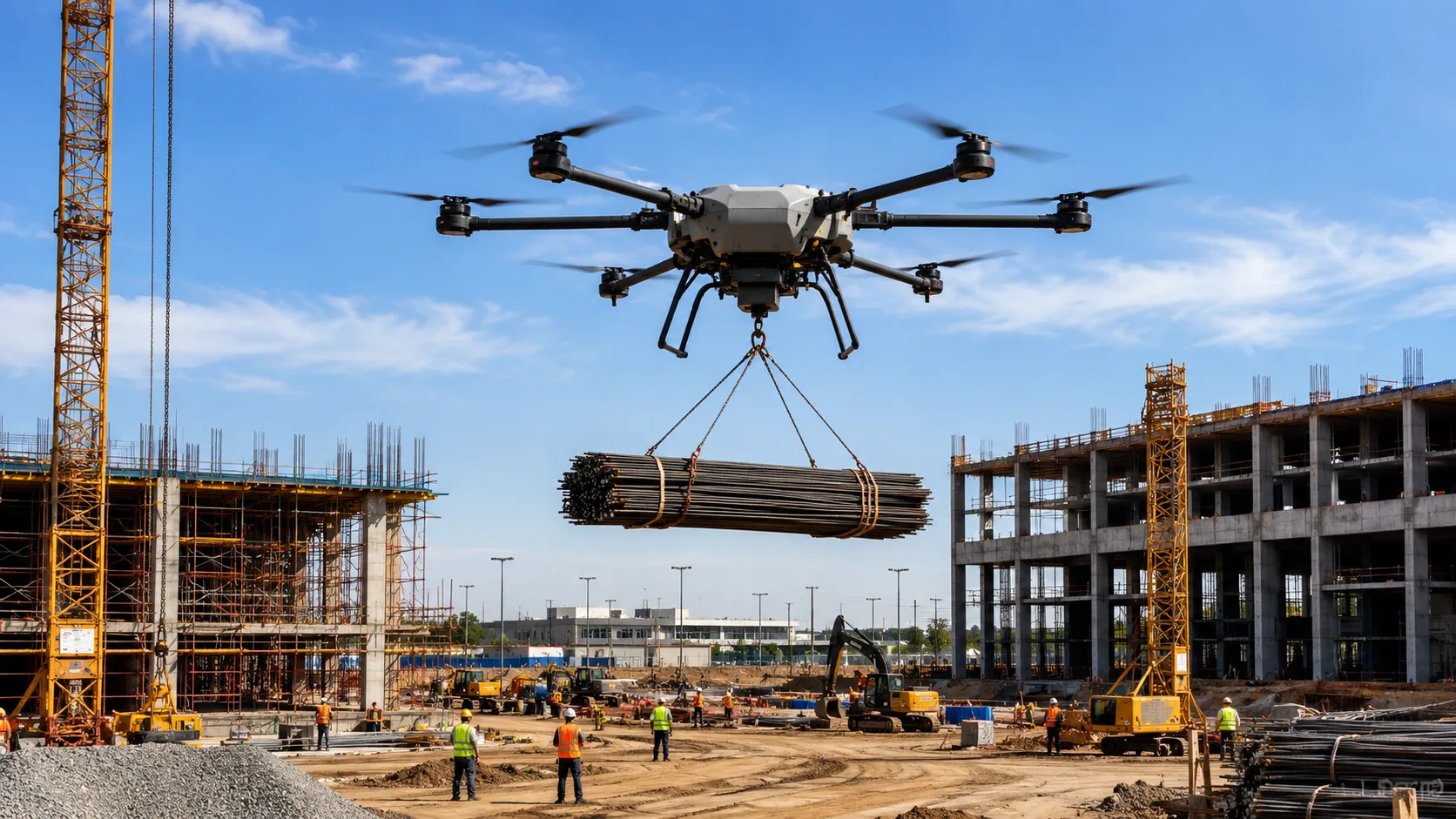
How a High-Payload UAV Improved Material Transport on a Large Construction Site
A construction-site deployment showing how a high-payload UAV helped teams move materials faster, reduce repeated manual transfers, and ease pressure on busy ground routes.
At A Glance
Use Case
Internal Material Transport
Platform Class
High-Payload / Heavy-Lift UAV
Deployment Fit
Short-Range Construction Logistics
Business Impact
Faster Transfers with Lower Ground Congestion
Large construction sites often face a familiar operational problem: materials need to move quickly, but short internal transfers still consume time, create interruptions, and add unnecessary pressure to already busy work areas. In this case, a high-payload UAV was introduced to improve short-distance material transport across a large and complex construction site where manual delivery was slowing response times and ground movement was creating avoidable bottlenecks.
The goal was not to replace the site's existing logistics setup. It was to add a faster transport option for repeated internal movements of tools, supplies, and worksite materials between active zones. By integrating a heavy-lift cargo UAV into daily operations, the project team created a more responsive transport layer that helped crews get what they needed faster without adding more friction to the jobsite workflow.
Project Background
The project took place on a large construction site with multiple active work zones distributed across a wide area. Materials needed to move regularly between storage points, staging areas, and specific work locations. Although the transfer distances were relatively short, the site layout, uneven ground, and constant equipment movement made routine ground delivery slower and less efficient than expected.
Teams often had to assign workers to carry tools or supplies across the site or coordinate vehicles for short internal deliveries. Over time, those small support trips created a larger operational problem: crews were interrupted, delivery response slowed down, and internal site traffic became harder to coordinate.
The project team needed a transport method that could improve responsiveness without adding more ground congestion or pulling skilled personnel away from their primary work.
The Operational Challenge
The issue was not a single oversized shipment. It was the accumulation of repeated short-range transport requests throughout the day. Even minor delays became costly when tools, parts, or materials had to be moved repeatedly between work zones to keep tasks progressing.
The team also wanted to reduce unnecessary foot traffic and vehicle movement in active construction areas. On a busy site, every extra trip creates ripple effects: crews stop work to support transport tasks, vehicles compete for access space, and site coordination becomes less efficient.
Safety was also part of the decision. Some delivery routes crossed uneven terrain, active equipment zones, or temporary access restrictions. Repeatedly sending people through those areas simply to move materials added exposure without adding much value. The project needed a more controlled way to handle routine internal transfers.
Why a High-Payload UAV Was Selected
A high-payload UAV was selected because it provided a practical way to move cargo directly between work zones without relying entirely on ground transport. The platform belonged to a heavy-lift class designed for industrial cargo missions, with payload capability scalable up to the 200-300 kg range depending on configuration and operating conditions. For this construction workflow, that meant more than enough lift capacity for repeated site-level transfers, plus the flexibility to support future transport demands as the project evolved.
The team chose this approach because it addressed several business needs at the same time:
- Faster delivery between active work zones.
- Lower pressure on internal ground routes.
- Less reliance on repeated manual handling.
- Reduced exposure to uneven or high-activity site areas.
- More responsive support for small but time-sensitive transport requests.
Importantly, the UAV was not intended to replace trucks, forklifts, or every existing transport method. It was used as a targeted logistics layer for short, repeated, time-sensitive material transfers that were slowing down the broader workflow. Teams evaluating similar deployments can also review our guide to choosing a heavy-lift drone for industrial use and our cargo transport solutions page for a broader planning view.
Deployment Workflow
The UAV was integrated into daily site operations as a support platform for internal material transport. When a crew needed tools, supplies, or small worksite materials from another part of the project, the cargo could be prepared, secured, and routed for aerial transport instead of depending on a manual run across the site.
The workflow followed a simple pattern:
- The team identified a transport request tied to an active work need.
- The cargo was prepared and secured for flight.
- The UAV was launched on a planned internal route.
- The materials were delivered to the required work zone.
- The receiving crew resumed work with less delay and less disruption.
This approach created value because the site had many short-distance delivery needs throughout the day. The UAV did not need to serve as a long-haul logistics platform to justify its role. Its real value came from reducing the friction of repeated internal transfers that would otherwise interrupt crews and slow site coordination.
It also helped preserve ground transport resources for tasks that genuinely required them, rather than using vehicles for small but frequent support movements.
Results
The deployment improved material transport in several ways that matter to construction teams.
First, it created a faster response path for internal deliveries. Materials that previously required manual movement or vehicle coordination could be moved more directly between work areas, helping crews stay productive instead of waiting for support logistics to catch up.
Second, it improved labor efficiency. By reducing repeated support trips, the site team could keep personnel focused on higher-value work rather than regularly pulling them away for internal material runs.
Third, it supported safer operations. Fewer manual trips through active work zones meant less unnecessary exposure to uneven surfaces, moving machinery, and temporary access restrictions.
Finally, it eased congestion across the site. Construction workflows often slow down when too many small movements compete for the same access space. The UAV gave the team a cleaner, more controlled way to complete short-range transport tasks without increasing pressure on already busy routes.
Why the Deployment Worked
This deployment worked because the UAV was matched to a repeatable logistics problem, not treated as a general-purpose replacement for every transport task. The team applied it where it delivered the greatest operational value: short, repeated, time-sensitive material movement inside a complex construction environment.
That mission fit is what made the solution commercially meaningful. High-payload UAVs are not only useful for remote logistics or emergency supply missions. In the right industrial setting, they can solve routine transport problems that quietly reduce productivity when handled manually.
The project also benefited because the UAV was built into the workflow rather than used as a one-off demonstration. Once it became part of a repeatable operating process, the business value became easier to realize and easier to justify.
Key Takeaway
For construction teams, a heavy-lift UAV can be a practical way to improve short-distance material transport, especially on sites that are large, active, or difficult to navigate efficiently from the ground. It can help teams move materials faster, reduce interruptions, and lower unnecessary exposure to active jobsite conditions.
The key lesson from this case is that high-payload drones are not only relevant for specialized cargo programs. In the right construction workflow, they can become a practical part of everyday site logistics by improving responsiveness without adding complexity.
For businesses evaluating industrial cargo UAVs, the most important question is not just how much the platform can lift. It is whether the system fits a real and repeatable transport problem inside the operation. When that fit is clear, a heavy-lift UAV becomes easier to justify as part of a productivity, safety, and workflow improvement strategy. For a broader pre-purchase view, see what businesses should know before choosing a heavy-lift cargo UAV.


Frequently Asked Questions
Why was a high-payload UAV used on this construction site?
+
It was used to improve short-distance material transport between active work zones where repeated manual delivery and ground movement were creating delays and unnecessary congestion.
Did the UAV replace all construction site transport methods?
+
No. It supported short, repeated, time-sensitive internal transfers, while trucks and forklifts still handled transport tasks that required conventional ground logistics.
What made the UAV deployment effective in this case?
+
The UAV was matched to a clear mission: frequent short-range material movement in a complex worksite. Its value came from fitting into the existing workflow rather than trying to replace every transport step.
Continue Exploring
Continue Exploring
Keep the momentum going with a few related reads selected to extend this topic into strategy, deployment, and practical field use.
Featured Read
What Businesses Should Know Before Choosing a Heavy-Lift Cargo UAV
Industrial Logistics · Apr 29, 2026
Recommended
Agriculture Drone Payloads Explained: Spraying, Spreading, Mapping and Multispectral Imaging
Agriculture Drones · Jul 31, 2026
Recommended
How UAVs Reduce Time and Cost in Land Mapping Projects
Mapping & Surveying · May 8, 2026
Recommended
Why Security Teams Are Adding Drones to Industrial Monitoring Workflows
Industrial Security · May 4, 2026
Recommended
How Stroni UAV Is Rethinking Automated Drone Cleaning
Cleaning Drone · Sep 14, 2026
Plan a Similar Cargo Workflow
Share your site conditions, payload class, and routing constraints to get a deployment recommendation tailored to industrial transport.