How a Multispectral UAV Helped a Farm Detect Crop Stress Before Yield Loss
An agriculture case study showing how a farm used a multispectral UAV to detect crop stress earlier, improve scouting efficiency, and intervene before visible symptoms translated into yield loss.
At A Glance
Industry
Agriculture
Use Case
Crop Stress Detection
Deployment Fit
Field Crop Monitoring
Operational Focus
Early Detection, Triage, Yield Protection
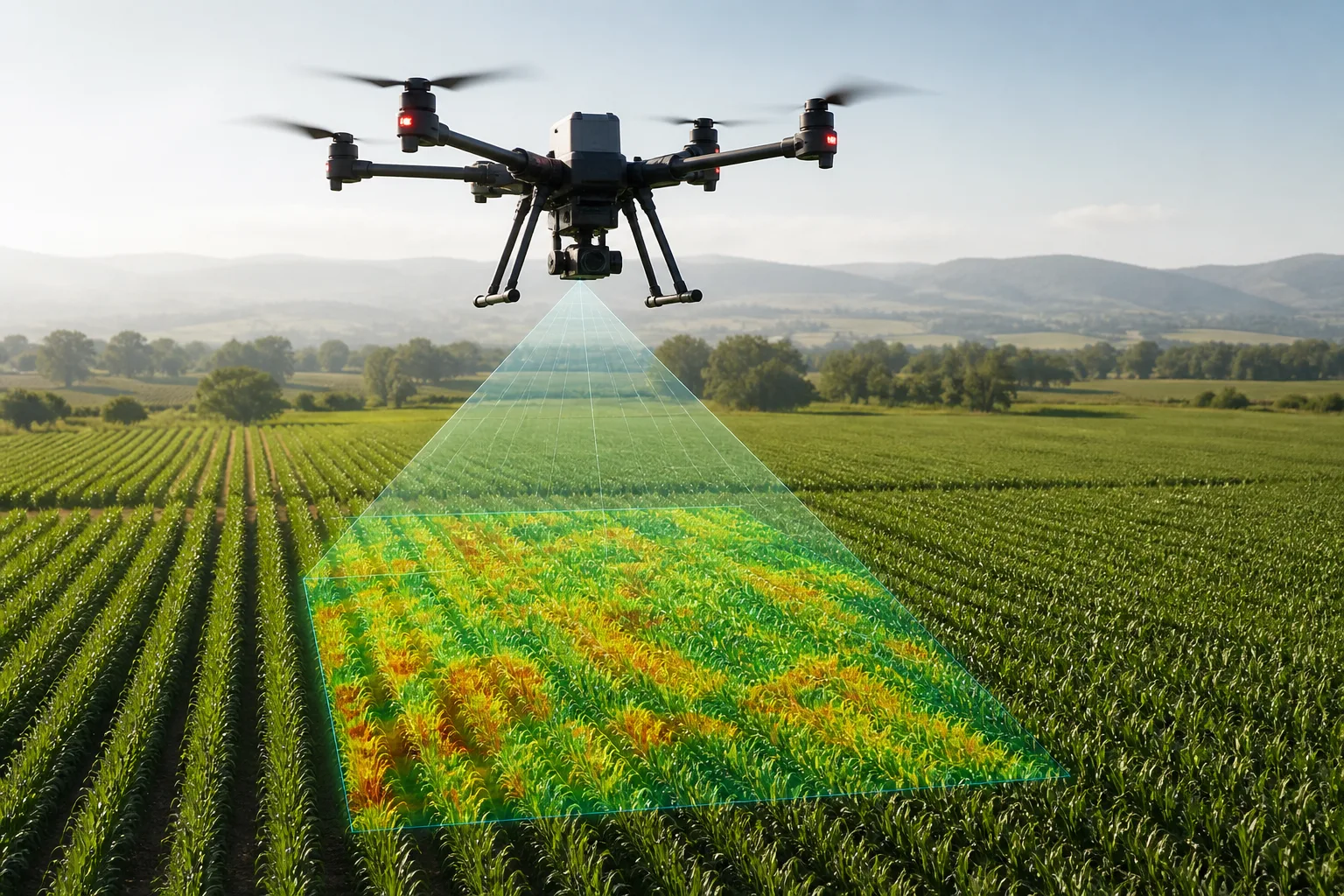
A farm needed a better way to identify crop stress before it became visible enough to damage yield. By the time discoloration, uneven growth, or weak plant performance could be seen clearly from the ground, the problem had often already advanced far enough to reduce intervention options and increase correction cost. To solve that issue, the farm introduced a multispectral UAV into its monitoring workflow and used it to detect stress earlier, assess more field area in less time, and direct follow-up inspections with far better precision than manual scouting alone could provide.
The goal was not to replace agronomists or in-field inspections. It was to give the farm earlier visibility into stress patterns that were not yet obvious to the naked eye. With multispectral imaging, the team gained a more data-driven view of crop health and a stronger opportunity to investigate root causes before stress translated into measurable yield loss.
The Monitoring Challenge
The farm managed multiple crop blocks that required regular monitoring throughout the growing season. Field scouting was already part of the agronomy process, but it depended heavily on visual observation and spot checks. That meant the team often had to wait until leaf color shifted, vigor declined, or growth irregularities became pronounced enough to detect by eye.
The weakness of that approach was timing. Stress caused by irrigation inconsistency, nutrient imbalance, disease pressure, or localized soil variation can begin affecting plant performance well before visible symptoms appear. By the time the issue became obvious on the ground, the farm had often already lost valuable response time.
The operation also faced a scale problem. Walking fields manually took time, and it was difficult to inspect every area with the same frequency or attention. Some zones received closer review than others, which made it harder to build a consistent picture of field performance across the season.
The farm needed a better monitoring method not only to see more, but to see sooner and prioritize action more effectively.
Why a Multispectral UAV Was the Right Fit
The farm selected a multispectral UAV because it could capture crop health signals beyond what conventional visual scouting could reliably identify. Instead of relying only on surface appearance, the platform helped reveal subtle variability in plant condition that often appears before stress becomes visible in standard field observation.
This made the UAV a strong fit for the operation for five practical reasons:
- Earlier stress detection: helping the team identify abnormal crop patterns before visible symptoms became widespread.
- Wider coverage in less time: allowing the farm to review more blocks on a repeatable schedule.
- More consistent monitoring: creating a clearer basis for comparing crop condition over time.
- Better targeting of field checks: helping agronomy teams focus attention on the zones most likely to require intervention.
- Stronger decision support: improving the farm's ability to connect aerial signals with irrigation, nutrition, or disease-management actions.
The UAV did not replace agronomic judgment. It improved it by helping the team understand where to look first, what patterns to investigate, and which field blocks required faster attention. Teams evaluating a broader farm operations stack can also review our precision agriculture guide, our crop monitoring workflow article, and our precision agriculture solutions page.
Deployment Workflow
The multispectral UAV was integrated into the farm's routine crop monitoring workflow rather than treated as a separate technology exercise. During key growth stages, the team scheduled flights over selected field blocks and used the resulting imagery to identify unusual crop-health patterns that warranted closer inspection.
The workflow typically followed six steps:
- Field selection: the agronomy team identified the blocks to be monitored based on crop stage, known variability, or recent field concerns.
- Multispectral flight: the UAV collected crop-health data across the target blocks.
- Stress-zone review: the team reviewed the data to flag areas showing abnormal patterns or reduced vigor.
- Cross-check with field conditions: the farm compared those zones against irrigation behavior, soil conditions, nutrient plans, and crop-development history.
- Targeted ground inspection: field teams visited the flagged zones to confirm the cause of the stress pattern.
- Corrective action: the farm adjusted irrigation, nutrient strategy, or crop-protection response where intervention was required.
This process changed the farm's monitoring model from reactive scouting to guided investigation. Instead of waiting for problems to become visible at the field edge, the team could identify anomalies earlier and direct field effort where it was most needed.
Operational Outcomes
The multispectral workflow improved the farm's monitoring process in several important ways.
First, it improved detection timing. Areas that looked relatively normal from the ground sometimes showed meaningful stress patterns in the aerial data, giving the farm an earlier opportunity to investigate before the condition worsened.
Second, it expanded coverage without expanding scouting effort at the same rate. The UAV allowed the farm to assess more field area on a regular basis, making monitoring more scalable across multiple blocks.
Third, it made field scouting more efficient. Instead of distributing attention evenly across the entire farm, the agronomy team could use the multispectral output to identify high-priority zones for follow-up inspection.
Fourth, it supported faster and more targeted intervention. When stress signals were detected early, the farm had more time to investigate likely causes and respond before the issue spread or became harder to correct.
Finally, it reduced the risk of preventable yield loss. Earlier visibility did not eliminate agronomic problems, but it gave the farm a better chance to respond while the situation was still manageable and before damage became obvious across the field.
Why the Deployment Worked
This deployment worked because it solved a real limitation in the farm's existing workflow: visual scouting alone was not enough to catch problems early. The multispectral UAV gave the team a more sensitive and repeatable view of crop condition, which improved both timing and prioritization.
The real value came from using the platform as a decision-support layer rather than as an imaging tool alone. The farm did not treat the UAV as a way to collect interesting pictures. It treated it as a way to direct agronomy effort, investigate stress earlier, and improve intervention timing.
That is where multispectral UAVs create the most value in agriculture. They do not just document what the field already looks like. They help reveal where crop performance is starting to diverge before the damage becomes obvious.
What This Means for Farm Operators
For farms trying to protect yield, a multispectral UAV can be a highly practical monitoring tool. It improves early stress detection, expands field coverage, and helps agronomy teams focus follow-up work where it can have the greatest effect.
This is especially valuable in operations where manual scouting is too slow to keep pace with field scale, and where earlier intervention can materially improve season outcomes. In those environments, multispectral monitoring supports more informed crop management and more efficient use of agronomy resources.
Key Takeaway
This case shows that early visibility is one of the most valuable advantages a farm can gain from UAV-based monitoring. When stress is detected before symptoms become obvious to the naked eye, the farm has more time, more options, and a better chance to protect yield.
For growers looking to move from reactive scouting toward more proactive crop management, a multispectral UAV can become a practical and commercially valuable part of the decision-making workflow.
Frequently Asked Questions
Why was a multispectral UAV a good fit for this farm?
+
Because the farm needed to detect crop stress earlier than visual scouting alone could allow and prioritize field intervention before symptoms became obvious enough to threaten yield.
What did the multispectral workflow improve?
+
It improved detection timing, expanded field coverage, made scouting more efficient, and helped the agronomy team focus ground checks and corrective action where stress signals appeared first.
Where do multispectral UAVs create the most value in agriculture?
+
They create the most value where farms need earlier stress detection, repeatable crop monitoring across large blocks, and better decision support for targeted intervention before yield loss occurs.
Continue Exploring
Continue Exploring
Keep the momentum going with a few related reads selected to extend this topic into strategy, deployment, and practical field use.
Featured Read
Agriculture Drone Manufacturer: 12 Questions Importers Should Ask Before Buying
Agriculture · Jul 28, 2026

Recommended
What Is Precision Agriculture? A Complete Guide for Modern Farming
Agriculture · Apr 12, 2026
Recommended
How Many Hectares Can a 50L Agriculture Drone Spray Per Hour?
Agriculture Drones · Jul 29, 2026

Recommended
Agriculture Drone Payloads Explained: Spraying, Spreading, Mapping and Multispectral Imaging
Agriculture Drones · Jul 31, 2026
Recommended
How Agricultural Spraying Drones Work: From Route Planning to Droplet Deposition
Agriculture Drones · Jul 31, 2026
Want outcomes like this?
Share your use case and we will map an implementation strategy with measurable operational milestones.