Solar Farm Thermal Inspection at Utility Scale
See how thermal drone inspection improved anomaly detection, maintenance prioritization, and O&M efficiency across a utility-scale solar farm.
At A Glance
Detection Throughput
+2.6x
Mean Time to Repair
-31%
Field Labor Hours
-45%
A utility-scale solar farm operates very differently from a small commercial rooftop system. With thousands or even millions of photovoltaic modules spread across a large site, the plant's operations and maintenance team faces a constant challenge: keeping production stable while inspecting a vast number of assets efficiently.
At this solar farm, routine inspection was a critical part of the industrial inspection workflow supporting the broader O&M program. The team needed to identify hotspots, underperforming modules, string-level issues, soiling patterns, and other thermal anomalies before they developed into larger production losses. However, as the site expanded, the existing inspection method became increasingly difficult to scale.
The asset owner needed a faster, more consistent way to inspect the full array, locate thermal defects accurately, and turn inspection findings into actionable maintenance tasks.
The O&M Challenge
Traditional ground-based inspection was slow and labor-intensive. Technicians had to move through long rows of panels, visually check equipment, and use handheld tools to investigate suspected issues. While this method could work for smaller sites, it was not efficient enough for a utility-scale solar farm where inspection speed directly affects maintenance response and asset performance.
The main challenge was scale. The solar farm covered a wide area, making full-site inspection time-consuming and difficult to repeat consistently. Thermal anomalies such as hotspots, failed cells, disconnected strings, bypass diode issues, and soiling-related irregularities could remain unnoticed until they affected production data and created unnecessary revenue loss.
Manual inspection also produced uneven coverage. Teams often focused on accessible areas or known problem zones, increasing the risk of missing hidden defects in less frequently reviewed sections of the site. And when anomalies were found, maintenance crews still needed additional time to locate the exact module or array section before corrective work could begin.
The O&M team needed a workflow that could scan the site quickly, detect abnormal heat signatures reliably, and deliver precise, location-based information for repair planning as part of a more structured inspection program design.
Why a Thermal UAV Was the Right Fit
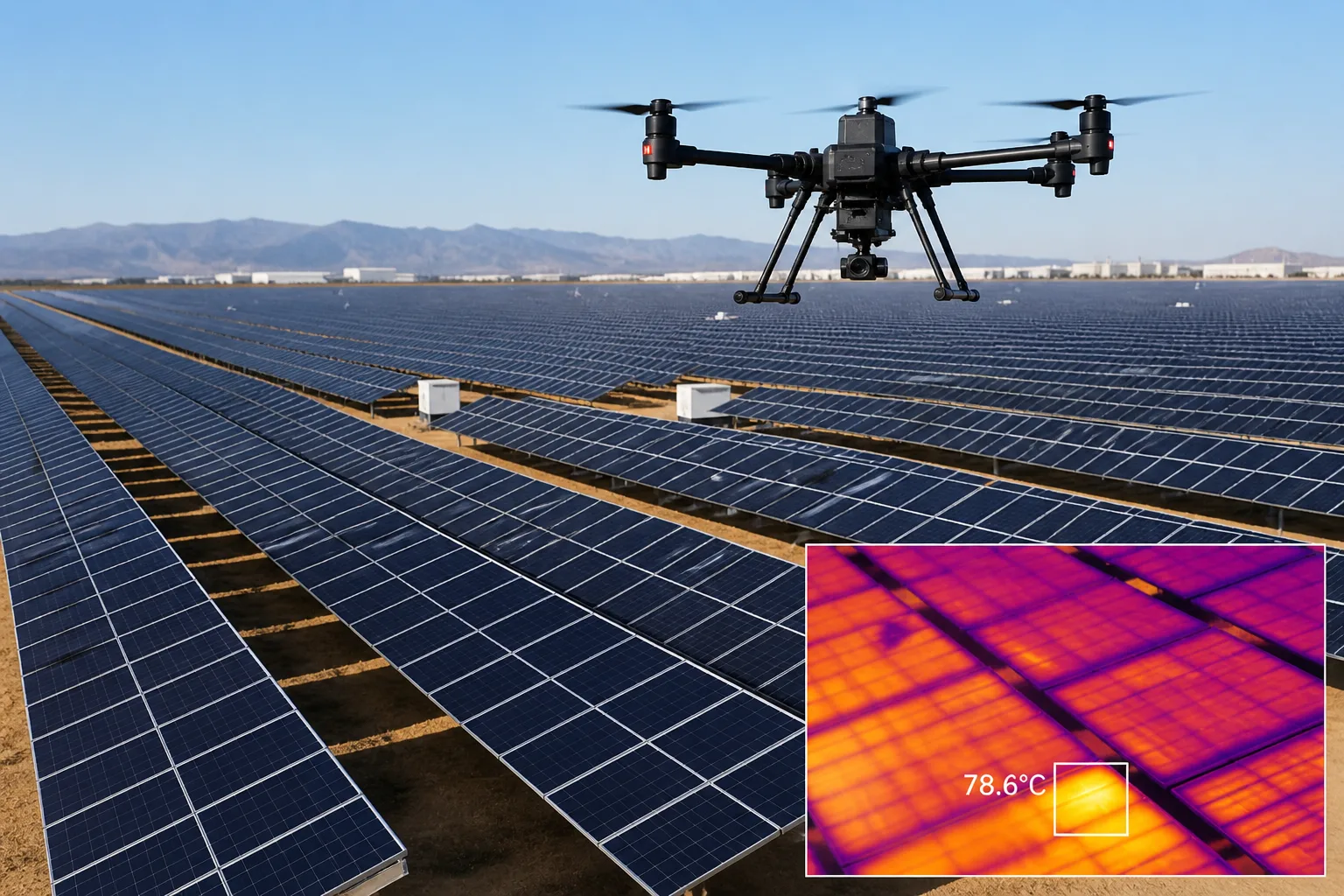
The solar farm introduced a thermal drone inspection workflow designed specifically for utility-scale photovoltaic assets. A UAV equipped with both infrared and visible-light cameras was deployed to scan the solar arrays from low altitude using pre-planned routes across the site.
This made the drone a strong fit for the operation because it could:
- Cover large sections quickly: reducing the time required to inspect utility-scale array fields.
- Detect heat-signature anomalies early: including module hotspots, damaged cells, string-level faults, bypass diode issues, and mismatch-related patterns.
- Pair thermal and visual evidence: helping teams distinguish between electrical faults, soiling, shading, debris, vegetation, or surface contamination.
- Create repeatable inspections: following structured flight routes to improve consistency across blocks and inspection cycles.
- Support faster maintenance planning: by mapping anomalies back to specific rows, strings, and module areas.
Instead of relying on technicians to walk the site panel by panel, the drone gave the solar operator a faster and more scalable way to collect actionable thermal data.
Inspection Workflow
The inspection was organized around a practical O&M workflow.
- Flight planning: the team built routes based on site layout, array orientation, row spacing, and inspection priorities to ensure safe coverage and reliable image overlap.
- Data collection: the UAV captured thermal and visible-light imagery across the solar arrays during suitable irradiance conditions so temperature differences could be clearly detected.
- Thermal anomaly detection: inspection teams reviewed the imagery to identify abnormal heat signatures and classify findings by severity and likely cause.
- Reporting and prioritization: each anomaly was documented with thermal evidence, visible-light reference, location data, estimated severity, probable issue type, and recommended follow-up action.
- Maintenance follow-up: repair teams used the report to go directly to affected modules and plan corrective work more efficiently.
This workflow shortened the gap between inspection, diagnosis, and corrective action while making full-array review more practical at utility scale.
Operational Outcomes
The thermal drone inspection improved the solar farm's O&M workflow in several important ways.
First, it accelerated site coverage. Large sections of the solar farm could be scanned much faster than with manual ground inspection, allowing the team to review more of the plant in less time.
Second, it improved anomaly location accuracy. By combining infrared data, visible-light context, and location tagging, the team could pinpoint abnormal modules and affected array sections with far less guesswork.
Third, it improved maintenance prioritization. The inspection report helped separate high-severity hotspots and string-level faults from lower-risk findings, so urgent issues could be addressed first instead of treating every anomaly with the same urgency. That also made it easier for operations teams to review inspection output inside a clearer UAV KPI dashboard and track response quality over time.
Fourth, it reduced manual inspection burden. Technicians spent less time walking long rows of panels under harsh field conditions and more time focused on diagnosis, repair, and performance improvement.
Finally, it helped protect asset availability. Earlier detection and targeted follow-up reduced the risk of prolonged underperformance and supported more stable energy output over time.
What This Means for Solar Asset Operators
Utility-scale solar farms are strong candidates for thermal drone inspection because they combine large asset footprints, high inspection demand, and constant pressure to maintain production efficiency. In this case, the operator needed a faster way to identify thermal anomalies, prioritize repairs, and keep energy production stable.
Thermal UAV inspection provided a scalable solution by scanning large photovoltaic arrays quickly, detecting hotspots and abnormal modules earlier, and delivering clear location-based reports for maintenance teams. For solar O&M teams, the value is not that inspection becomes more advanced in theory. The value is operational: faster defect detection, more accurate maintenance planning, lower manual inspection burden, and better protection of energy output.
As utility-scale solar assets continue to grow, thermal drone inspection is becoming an increasingly practical tool for keeping large photovoltaic plants reliable, efficient, and easier to manage.

Frequently Asked Questions
Why is thermal UAV inspection a strong fit for utility-scale solar farms?
+
Because large photovoltaic sites require faster and more consistent inspection coverage than ground-only methods can usually provide, especially when anomaly location and maintenance response speed matter.
What kinds of issues can thermal drone inspection help identify?
+
It can help surface module hotspots, failed cells, string-level faults, bypass diode anomalies, soiling patterns, shading-related heat signatures, and underperforming panel groups.
What operational value does this workflow create for O&M teams?
+
It reduces inspection time, improves anomaly localization, supports maintenance prioritization, lowers manual inspection burden, and helps protect asset availability by enabling earlier corrective action.
Continue Exploring
Continue Exploring
Keep the momentum going with a few related reads selected to extend this topic into strategy, deployment, and practical field use.
Featured Read
Why UAV Inspection Is Becoming Standard in Industrial Operations
Industrial Inspection · Mar 29, 2026
Recommended
What to Look for in an Industrial Inspection UAV
Industrial Inspection · Mar 21, 2026
Recommended
How Drones Fit Into Industrial Monitoring Workflows
Industrial Inspection · Apr 5, 2026
Recommended
How Many Hectares Can a 50L Agriculture Drone Spray Per Hour?
Agriculture Drones · Jul 29, 2026

Recommended
How Stroni UAV Is Rethinking Automated Drone Cleaning
Cleaning Drone · Sep 14, 2026
Map Your Inspection Deployment
Tell us about your assets, inspection frequency, and data requirements to shape a practical UAV workflow for your team.