
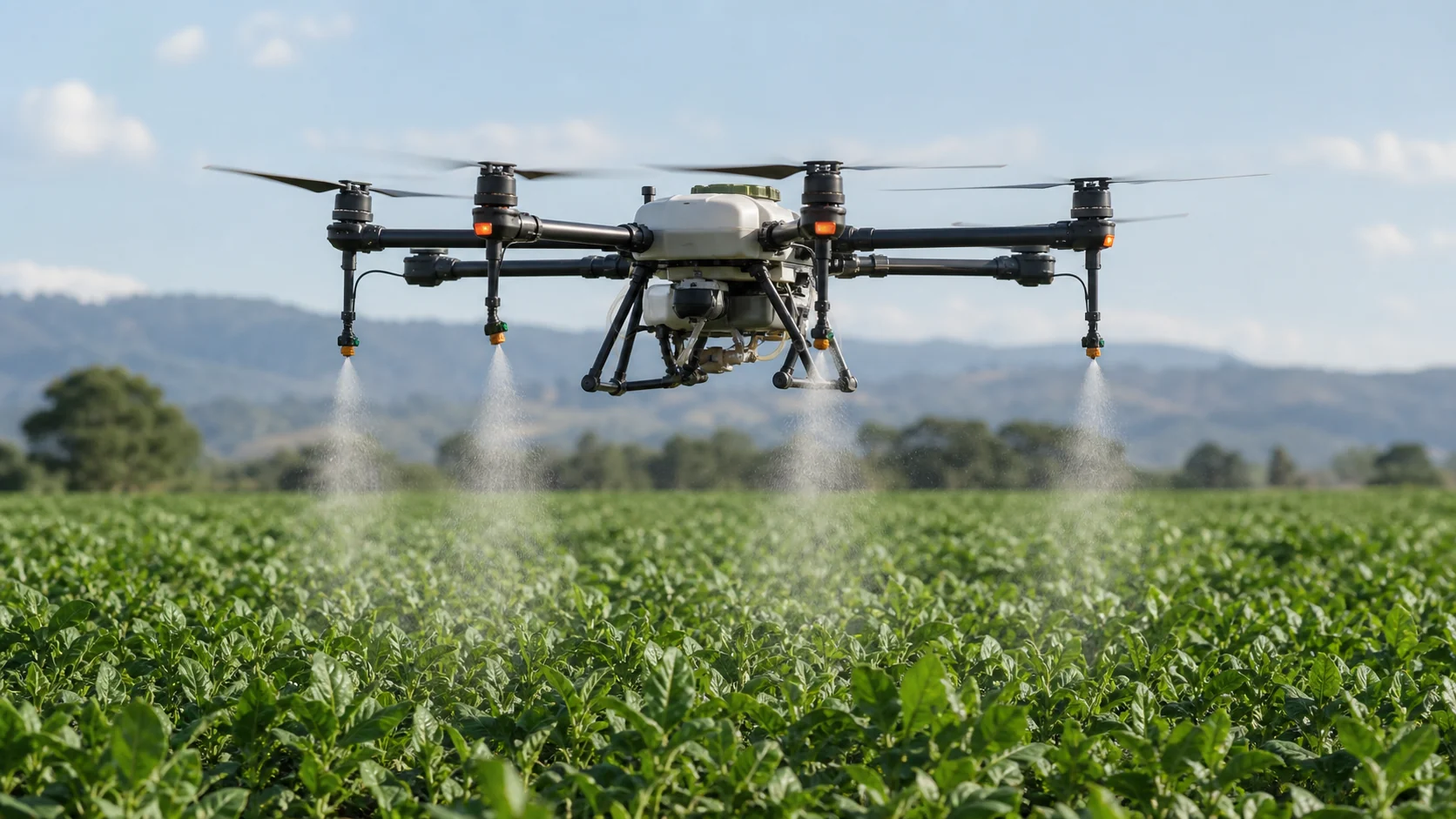
How Agricultural Spraying Drones Work: From Route Planning to Droplet Deposition
A technical but accessible explanation of flight control, pumps, atomizers, downwash, calibration, and field operation.

July 31, 2026
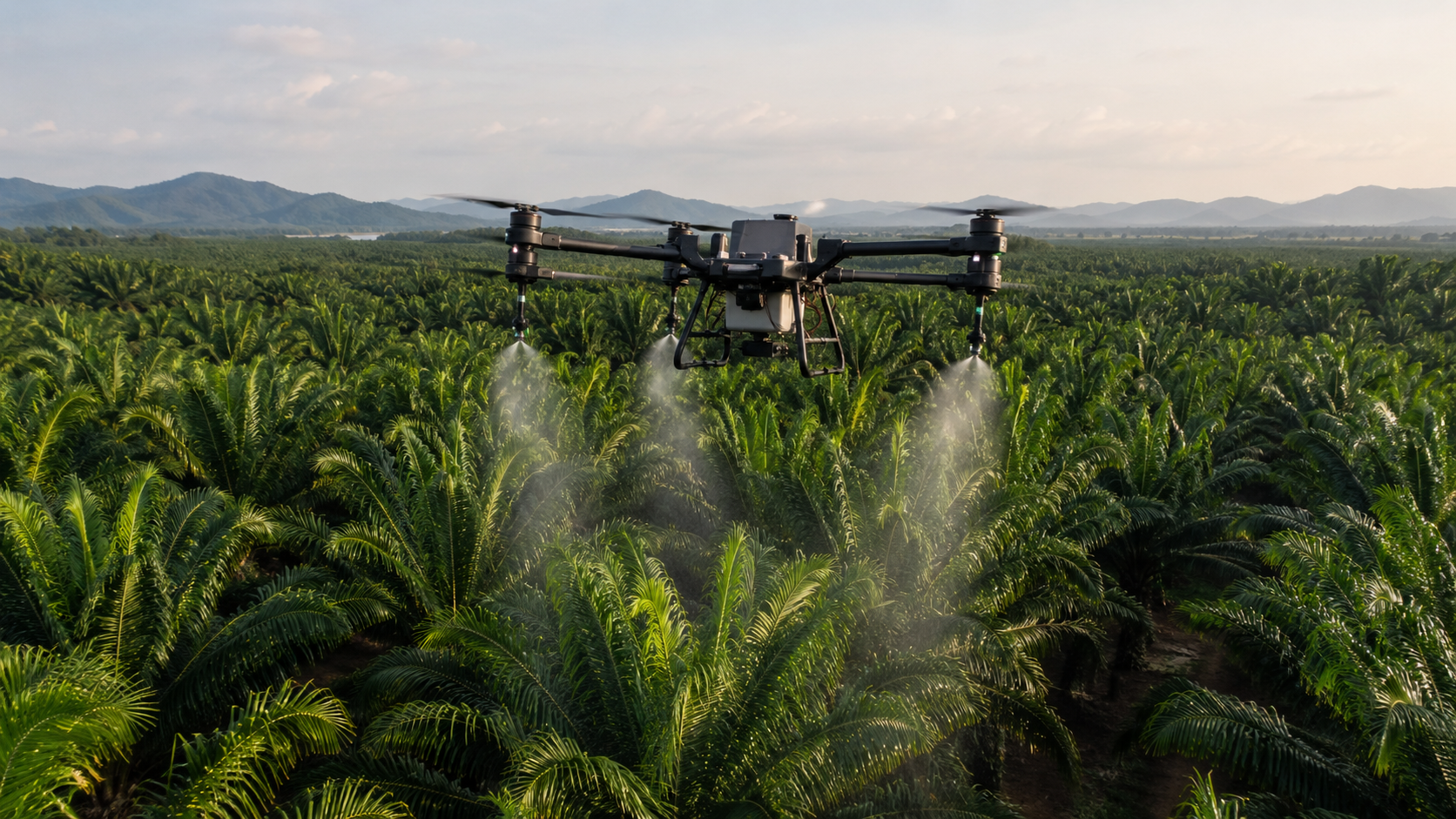
An agricultural spraying drone is more than a flying tank. It is a coordinated system in which the aircraft, navigation software, liquid circuit, nozzles or atomizers, rotor airflow, and operator settings work together.
The aircraft must move along the correct route. The liquid system must deliver the intended flow. The droplets must reach the target with acceptable coverage while limiting drift and avoiding missed or repeated areas.
Understanding this process helps operators and agricultural teams see why spraying results cannot be predicted from tank capacity alone.
The Five Parts of a Spraying Drone System
Most agricultural spraying drones include five functional groups.
1. Flight Platform
The frame, motors, propellers, electronic speed controllers, and battery create and control lift. The propulsion system must carry the aircraft, liquid, application hardware, sensors, and battery while maintaining stable flight.
2. Navigation and Flight Control
The flight controller combines satellite positioning, inertial sensors, altitude information, and operator commands. It stabilizes the aircraft and follows the mission route.
RTK positioning may be used where closer route alignment is needed. Terrain-following sensors can help the drone maintain a more consistent distance above the crop or ground.
3. Liquid Delivery System
The tank stores the spray mixture. Pumps move liquid through filters, hoses, valves, and flow sensors toward the nozzles or atomizers.
The controller may adjust flow as flight speed changes so that application remains closer to the configured rate.
4. Atomization System
Nozzles or rotary atomizers break the liquid into droplets. The resulting droplet spectrum affects coverage, canopy penetration, evaporation, and drift potential.
5. Mission Software
Mission software defines the field boundary, route direction, pass spacing, speed, height, turns, and exclusion zones. It may also record flight paths and application information.
Step 1: Mapping the Operating Area
Before spraying, the field must be understood as a three-dimensional operating environment.
The operator identifies:
Field boundaries
Crop rows and canopy height
Trees, poles, wires, buildings, and irrigation structures
Roads, people, animals, and neighboring property
Waterways and environmentally sensitive areas
Slopes and sudden terrain changes
Suitable takeoff, landing, refill, and battery areas
Field boundaries can be walked, mapped, imported, or created using another aerial survey, depending on the platform and local workflow.
The map is not merely a shape on a screen. It is the basis for route planning and risk control.
Step 2: Creating the Flight Route
The software divides the field into parallel or crop-aligned passes.
Route design considers:
Effective spray width
Desired overlap between passes
Wind direction
Crop-row direction
Terrain and obstacles
Turn space at boundaries
Refill and battery location
Route direction can affect efficiency and spray behavior. In row crops and orchards, alignment with planting structure may improve clearance and consistency. In irregular fields, the planner must avoid short fragments and unsafe turns where possible.
Step 3: Setting Application Parameters
The main parameters are connected. Changing one can affect the others.
Application Volume
Application volume describes how much liquid is intended for a unit of area. It should follow the crop-protection product label, agronomic recommendation, crop stage, target, and local requirements.
Flight Speed
Higher speed covers distance more quickly, but the flow system must keep pace and the droplets have less time to move into the canopy. Speed can also change rotor airflow and deposition behavior.
Height Above the Canopy
Flight height influences the distance droplets travel and the structure of the rotor downwash at the crop. Excessive height can increase exposure to crosswind and evaporation. Flying too low can create uneven airflow, crop disturbance, or collision risk.
Pass Spacing
Pass spacing should reflect the effective spray swath, not simply the maximum advertised width. Excessive spacing can create gaps. Too much overlap can create repeated application.
Flow Rate
Flow rate must match speed, pass spacing, and intended application volume. A calibrated control system adjusts liquid delivery according to the mission settings.
Step 4: Preparing the Spray System
Before filling the tank with an approved mixture, operators inspect the liquid circuit.
Typical checks include:
Tank, cap, seals, and outlet
Hoses and connections
Filters
Pumps and valves
Flow sensors
Nozzles or rotary atomizers
Leaks and blockages
Clean-water operation
Chemical products should only be mixed and applied according to their labels, local rules, and professional agricultural guidance. Compatibility tests may be needed where multiple approved products or additives are used.
The operator should wear appropriate protective equipment and keep mixing and refill areas controlled.
Step 5: Turning Liquid Into Droplets
The atomization system determines how liquid leaves the aircraft.
Hydraulic Nozzles
Hydraulic nozzles use pressure and nozzle geometry to form a spray. Different nozzle designs create different flow rates, fan patterns, and droplet spectra.
Rotary Atomizers
Rotary atomizers feed liquid onto a spinning disc. Rotational speed and liquid flow influence the droplet spectrum.
Droplets are not all identical. A spray contains a range of sizes. Finer droplets may provide more potential contact points but are generally more vulnerable to movement and evaporation. Coarser droplets are less drift-prone but may produce different coverage and canopy interaction.
The correct balance depends on the target, crop canopy, approved product instructions, weather, and application system.
Step 6: Using Rotor Downwash
Multirotor aircraft push air downward to generate lift. This downwash interacts with the spray plume and crop canopy.
It can help:
Carry droplets toward the crop
Move leaves and expose canopy surfaces
Support penetration into some canopy structures
It can also create:
Uneven distribution if height or route spacing is unsuitable
Strong movement near the center of the aircraft
Complex airflow around dense or tall plants
Greater off-target movement when combined with crosswind
Downwash changes with aircraft design, payload mass, rotor speed, flight speed, height, and surrounding air. This is why one universal set of spray parameters cannot describe every drone and crop.
Step 7: Terrain Following and Height Control
Maintaining a consistent height above the target helps stabilize spraying conditions.
Terrain-following sensors measure distance to the ground or crop and provide information to the flight controller. On sloping or uneven land, the system adjusts altitude along the route.
Sensor performance can be affected by:
Sudden terrain edges
Water surfaces
Dense or irregular canopy
Wires and narrow branches
Sensor angle and mounting
Weather and visibility
The operator should inspect the site and understand sensor limits. Terrain following supports route execution but does not replace obstacle planning.
Step 8: Monitoring the Mission
During flight, the operator monitors both the aircraft and the field.
Important information may include:
Position and route progress
Aircraft height and speed
Battery status
Remaining liquid
Pump and flow status
Positioning quality
Communication link
Warnings and sensor messages
People, vehicles, animals, and changing weather
The operator must be prepared to pause, return, land, or take manual control according to system procedures and local rules.
Step 9: Refill and Battery Rotation
Agricultural spraying usually involves repeated cycles.
A disciplined ground process helps prevent errors:
Land in a controlled area.
Stop the propulsion system according to procedure.
Inspect the aircraft and application system.
Replace or recharge the battery following battery-safety guidance.
Refill without contaminating people, equipment, or the environment.
Confirm the correct mission-resume point.
Restart only after the area is clear.
Checklists are useful because fatigue and repetition can cause missed steps during long operating periods.
Step 10: Cleaning and Post-Flight Inspection
After operation, the spraying system should be cleaned according to the product label, equipment manual, and environmental rules.
Post-flight work may include:
Emptying and rinsing the tank safely
Cleaning filters, hoses, pumps, and atomizers
Inspecting for leaks, residue, and chemical damage
Checking propellers, motors, arms, and landing gear
Reviewing battery condition
Recording alarms or unusual behavior
Storing equipment in a dry, controlled location
Residue should never be discharged into waterways or unmanaged ground.
Why Calibration Matters
Calibration connects the value entered into the software with the result produced in the field.
A calibration process may verify:
Actual pump output
Flow-sensor accuracy
Nozzle or atomizer condition
Effective pass width
Distribution across the swath
Droplet coverage and canopy deposition
Water-sensitive cards, collection materials, or other suitable test methods can help evaluate distribution before larger work begins.
Calibration should be repeated after changing nozzles, pumps, flow settings, payload configuration, or material. Wear and blockage can also change output over time.
Weather and Spray Behavior
Weather can change quickly at the field.
Wind
Wind affects flight, route alignment, and droplet movement. Direction matters as much as speed because it determines where off-target material may travel.
Temperature and Humidity
Hot and dry conditions can increase droplet evaporation. They can also affect batteries, operators, and crop response.
Rain
Rain can affect flight safety, equipment, and the effectiveness of applied products. Product labels and local guidance should determine suitable rain-free periods.
Operators should use current field observations rather than relying only on a distant weather forecast.
Field Crops and Orchards Require Different Thinking
Open field crops often allow long, repeatable passes. Orchards introduce tall canopies, rows, gaps, slopes, and branches.
In orchards, the team may need to consider:
Canopy side and top coverage
Row direction
Tree height variation
Penetration into dense foliage
Clearance from branches
Terrain changes
Different routes for different growth stages
Our citrus orchard UAV case study illustrates why access and canopy structure matter when planning aerial operations.
What the Drone Can and Cannot Do
A spraying drone can execute a planned route, regulate flow, and record operational data. It cannot independently decide whether a chemical is legally or agronomically appropriate, identify every hazard, or guarantee deposition under all conditions.
Safe and effective use requires:
A suitable aircraft and spray system
Trained people
Correct product instructions
Field assessment
Calibration
Weather judgment
Maintenance
Local regulatory compliance
Explore Agriculture UAV Systems
Stroni UAV provides civil agriculture platforms for spraying, spreading, and precision-farming applications. Readers can explore the agriculture UAV product range, review the precision agriculture solution, and learn more about agriculture drones in China.
For technical specifications or application information, email info@stroniuav.com.
Frequently Asked Questions
How does a spraying drone control application rate?
The system coordinates pump output with flight speed, route spacing, and the configured liquid volume per area. Calibration is needed to confirm actual performance.
What is rotor downwash?
Downwash is the downward airflow produced by the rotors. It influences droplet movement, crop-canopy motion, deposition, and spray distribution.
Why does flight height matter during spraying?
Height changes droplet travel distance, downwash behavior, obstacle clearance, and exposure to wind. The suitable height depends on the aircraft, crop, terrain, and application conditions.
Can a spraying drone operate fully automatically?
It can follow an autonomous route, but trained supervision, site assessment, mission monitoring, and the ability to intervene remain necessary.
About the Author:Wei Chen is the Chief UAV Engineer at Stroni, focusing on the architectural design and flight control system optimization of industrial multi-rotor platforms. Learn more →
Frequently Asked Questions
What is this article about?
+
Understand how agricultural spraying drones combine autonomous flight, liquid delivery, atomization, rotor downwash, and calibration to treat crops.
Who is this for?
+
It is written for teams planning, operating, or scaling enterprise drone workflows.
Where can I find related examples?
+
Use the related case studies and solutions on this page to review similar field applications.
Continue Exploring
Continue Exploring
Keep the momentum going with a few related reads selected to extend this topic into strategy, deployment, and practical field use.
Featured Read
How Much Does an Agricultural Spraying Drone Cost in 2026? Complete Price Guide
Agriculture Drones · Jul 3, 2026
Recommended
Agriculture Drone Payloads Explained: Spraying, Spreading, Mapping and Multispectral Imaging
Agriculture Drones · Jul 31, 2026
Recommended
Agriculture Drones in China: Technology, Applications and Operating Principles
Agriculture Drones · Jul 31, 2026
Recommended
Agriculture Drone Cost per Hectare: Battery, Labor and ROI Calculator
Agriculture Drones · Jul 29, 2026
Recommended
How Many Hectares Can a 50L Agriculture Drone Spray Per Hour?
Agriculture Drones · Jul 29, 2026

Want more industry insights?
Explore drone applications, implementation playbooks, and operational best practices with our editorial team.