
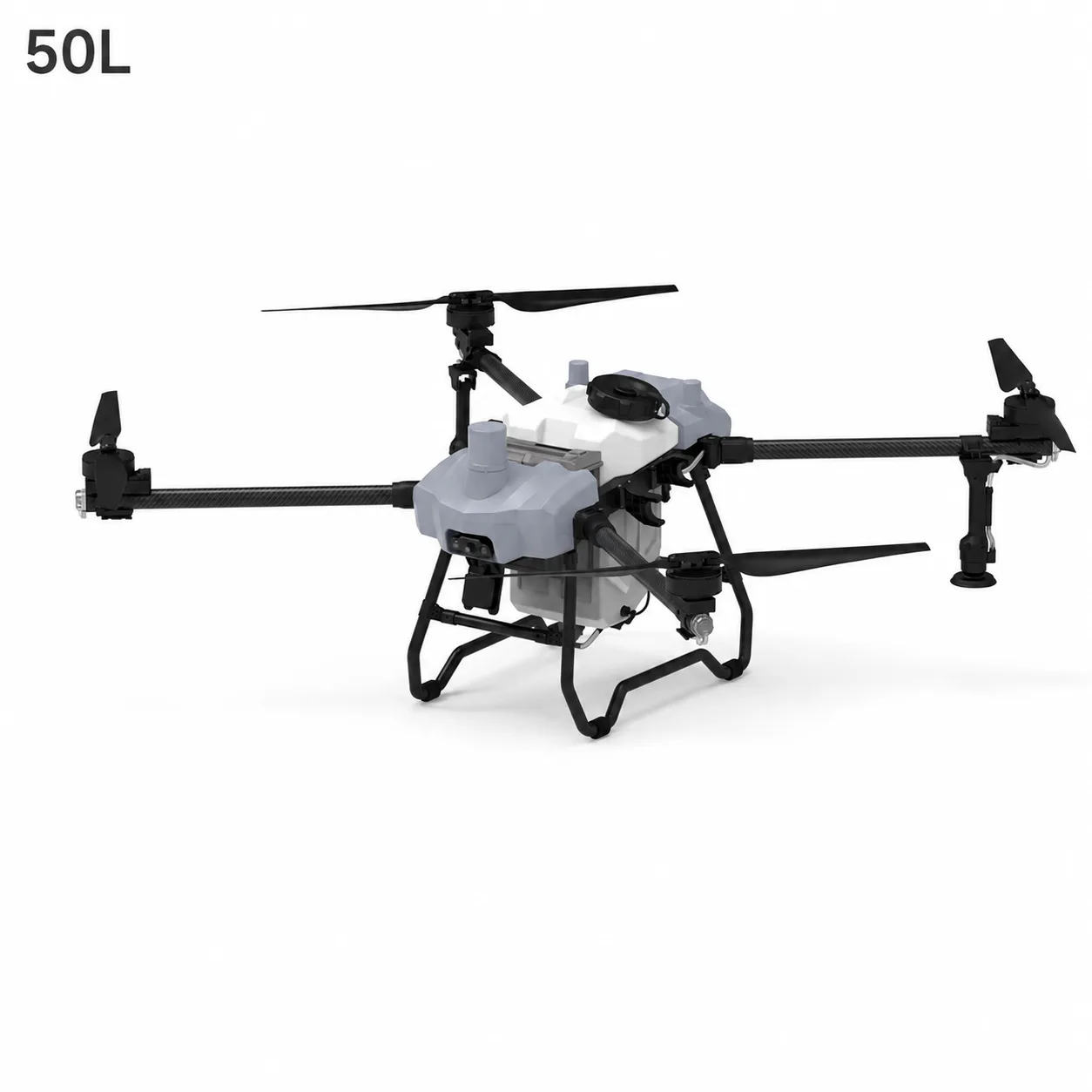
A 50L agriculture drone does not have one universal hectares-per-hour figure. Tank size matters, but actual output also depends on effective spray width, flight speed, application rate, field shape, terrain, refill time, battery turnaround, weather, and local operating limits.
For buyers comparing platforms, the useful question is not simply, 'How large is the tank?' It is, 'How many hectares can the complete field workflow treat in the conditions where we will operate?' This guide shows how to calculate that answer without confusing a catalog maximum with a realistic working result.
Quick answer
In an illustrative flat-field scenario using a 10 m effective swath, 5 m/s ground speed, and 70% field efficiency, the calculated net airborne coverage is 12.6 ha/h. This is an example, not a Stroni performance guarantee. Real output may be lower or higher after the application rate, turns, obstacles, refill, battery, weather, and operator workflow are considered.
First, Separate Three Different Productivity Numbers
Coverage claims become confusing when three different metrics are treated as if they mean the same thing. A serious evaluation should keep them separate.
Theoretical coverage rate - What it measures: Area crossed while the drone is moving on productive spray lines; What it excludes: Turns, overlap, obstacles, refill, battery service, and weather delays
Net field rate - What it measures: Productive spraying after field shape, turns, overlap, and normal interruptions; What it excludes: Long breaks, transport between sites, and major weather downtime
Daily output - What it measures: Total hectares completed during an operating day; What it excludes: Nothing: this is the operational result buyers should plan around
A headline such as 'up to 20 ha/h' may describe an optimized airborne test. It does not automatically mean an operator will complete 160 hectares in an eight-hour day. Daily output depends on how efficiently the whole system moves from mixing to spraying, landing, refilling, changing or charging batteries, checking the aircraft, and launching again.
Formula 1: Calculate Airborne Area Coverage
Coverage formula
Coverage rate (ha/h) = effective swath width (m) x ground speed (m/s) x 0.36 x field efficiency
The factor 0.36 converts square meters per second into hectares per hour. Field efficiency is entered as a decimal. For example, 70% becomes 0.70.
Use effective swath, not the widest number on a brochure. Effective swath is the spacing that produces acceptable coverage under the chosen height, droplet size, crop canopy, wind, and overlap. A product may support a broad spray-width range, but the correct working width must be confirmed through application testing.
Complex or narrow field - Effective swath: 6 m; Speed: 4 m/s; Field efficiency: 65%; Calculated coverage: 5.6 ha/h
Open-field planning case - Effective swath: 10 m; Speed: 5 m/s; Field efficiency: 70%; Calculated coverage: 12.6 ha/h
Wide, efficient field - Effective swath: 14 m; Speed: 6 m/s; Field efficiency: 75%; Calculated coverage: 22.7 ha/h
These scenarios are calculation examples only. They are not recommended settings, verified field-test results, or guarantees. The aircraft must always be operated within its validated configuration, the product label, agronomic requirements, weather limits, and local rules.
Formula 2: Check How Much Area One 50L Tank Can Treat
Tank coverage formula
Area per tank (ha) = tank volume (L) / application rate (L/ha)
The application rate often changes the result more than buyers expect. A 50L tank can cover 5 hectares at 10 L/ha, but only 1.67 hectares at 30 L/ha. Neither rate is automatically correct; the appropriate rate depends on the crop, canopy, treatment objective, chemical label, nozzle setup, and agronomic plan.
10 L/ha - Area per 50L tank: 5.00 ha; Tanks needed for 100 ha: 20
15 L/ha - Area per 50L tank: 3.33 ha; Tanks needed for 100 ha: About 30
20 L/ha - Area per 50L tank: 2.50 ha; Tanks needed for 100 ha: 40
30 L/ha - Area per 50L tank: 1.67 ha; Tanks needed for 100 ha: About 60
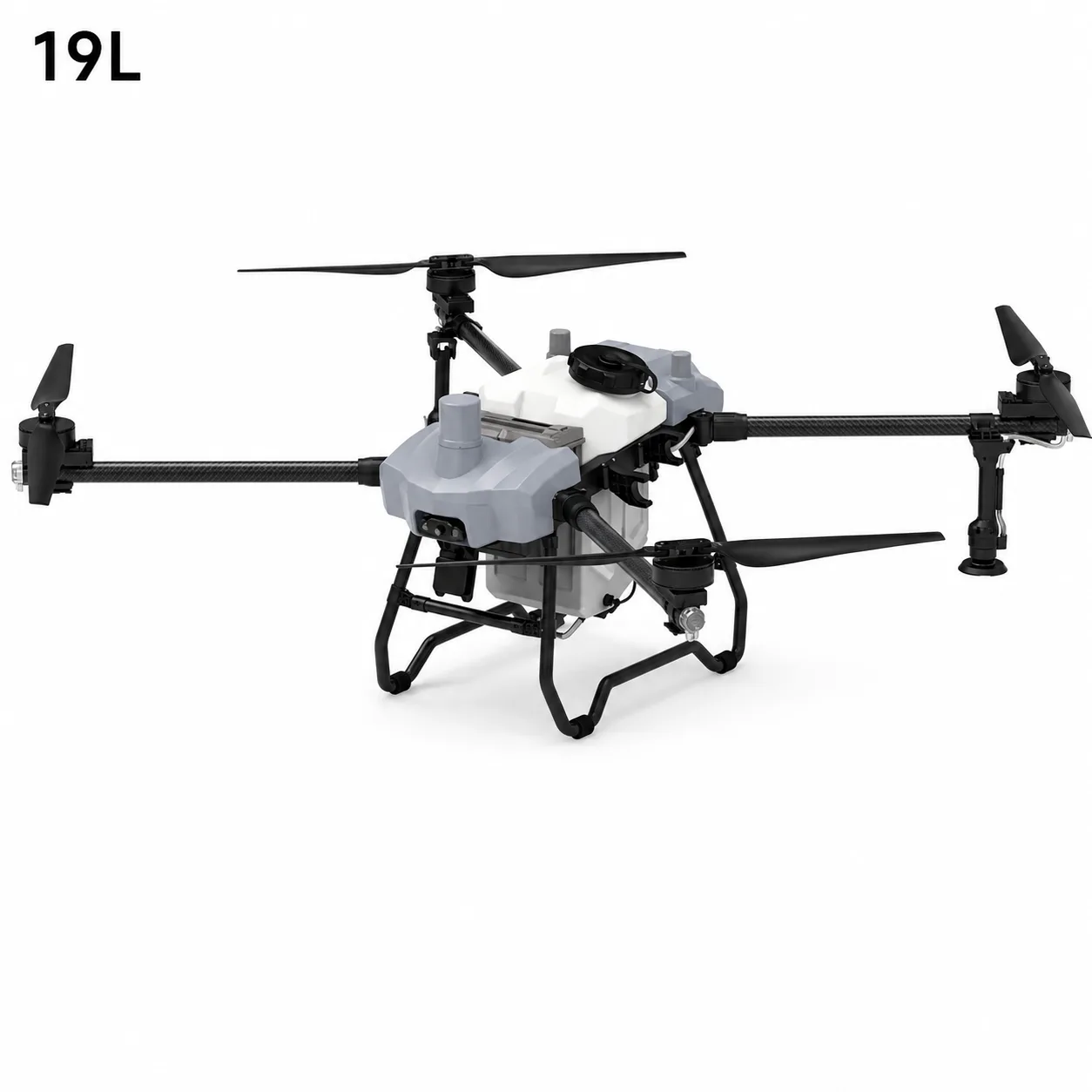
Stroni's 50L agricultural spraying drone is listed with a 50L liquid capacity, an 8-20 m spray-width range, and a 12-24 L/min spray-system flow specification. The flow capability is not a direction to spray at the maximum setting. Required operating flow should be calculated from the target application rate and real coverage rate.
Formula 3: Check the Required Liquid Flow
Required flow formula
Required flow (L/min) = application rate (L/ha) x coverage rate (ha/h) / 60
Using the illustrative 12.6 ha/h coverage case, an application rate of 10 L/ha requires 2.1 L/min. At 20 L/ha, it requires 4.2 L/min. At 30 L/ha, it requires 6.3 L/min. This check helps determine whether the planned speed, width, and application rate fit the spray system while preserving the required treatment volume.
If the required flow is outside the validated operating range, do not force the numbers. Adjust speed, effective swath, nozzle setup, or mission design, then confirm the result through a controlled calibration test.
Formula 4: Convert Tank Cycles Into Real Field Output
Cycle-based formula
Net field rate (ha/h) = area per tank (ha) x 60 / complete cycle time (minutes)
The complete cycle starts when one productive tank begins and ends when the next productive tank begins. It includes spraying, turning, return, landing, refill, battery handling, basic checks, and relaunch.
For example, at 20 L/ha a 50L tank treats 2.5 hectares. If the measured complete cycle is 12 minutes, the cycle-based field rate is 12.5 ha/h. If the same cycle takes 18 minutes because water and charging are poorly positioned, output falls to 8.3 ha/h. This is why a well-organized support workflow can matter as much as the aircraft's peak specification.
Why Real Output Changes From One Farm to Another
Field shape and obstacles: short rows, trees, poles, waterways, buildings, and irregular boundaries increase non-spraying time.
Terrain and crop structure: slopes, terraces, orchards, and tall or uneven canopies may require lower speed and more conservative spacing.
Wind and weather: wind can narrow the usable operating window and change the effective swath and drift risk.
Application rate: higher L/ha settings reduce area per tank and increase refill frequency.
Refill layout: clean water, mixing, measurement, and loading should be positioned to reduce waiting without compromising safe handling.
Battery and charging plan: aircraft quantity alone does not determine throughput; batteries, chargers, power supply, cooling, and charging discipline must work as one system.
Operator experience: route planning, calibration, inspection, and crew coordination influence both output and consistency.
Local rules and product labels: operating height, distance, chemical use, buffer zones, and permitted conditions can limit the theoretical plan.
A Better Way to Compare 50L Agriculture Drones
When evaluating suppliers, ask for the assumptions behind every productivity claim. A useful comparison should include:
Tank volume and usable liquid volume
Validated spray-width range and the field-test conditions used
Spray-system flow range and nozzle configuration
Tested speed, height, crop, terrain, wind, and application rate
Measured cycle time, including refill and battery turnaround
Battery and charging configuration used during the test
Overlap, turns, and field-efficiency assumptions
Whether the quoted result is theoretical, measured airborne output, or full-day output
If a supplier gives only a single hectares-per-hour number, the comparison is incomplete. Ask for the test sheet or recreate the calculation using your own crop and field conditions.
How to Estimate Daily Capacity Before Buying
Define the crop, treatment objective, and target application rate in L/ha.
Map typical field size, shape, obstacles, terrain, and distance between operating sites.
Choose a conservative effective swath and ground speed for the actual field, not the brochure maximum.
Calculate airborne coverage and required liquid flow.
Estimate area per tank and measure or model the full tank cycle.
Build the battery, charger, power, water, mixing, spare-parts, and crew plan around that cycle.
Run a controlled field trial and record hectares, liquid used, active time, service time, and downtime.
Use the measured net field rate to plan daily capacity and project economics.
Is a 50L Platform the Right Size?
A 50L drone can be a practical middle-to-high-capacity option for commercial farms, contractors, plantations, and distributors serving repeat spraying demand. However, the best capacity depends on the operating model. Smaller platforms may be easier to transport and deploy in fragmented fields. Larger platforms can reduce refill frequency in open areas, but they may require more demanding logistics, power, transport, and crew preparation.
The right decision should be based on hectares per site, application rate, field access, transport limits, available power, crew capability, spare-parts support, and expected seasonal utilization. Tank size is one part of that system, not the whole answer.
Plan Your 50L Drone Workflow With Stroni
Stroni supplies civil agriculture UAV platforms for spraying, spreading, and precision-farming workflows. For a more useful recommendation, send us your country, crop, typical field size, terrain, target application rate, and expected hectares per day. We can review the requirement and suggest a practical aircraft, battery, charging, spare-parts, and training configuration by email.
Related Stroni Resources

About the Author:Wei Chen is the Chief UAV Engineer at Stroni, focusing on the architectural design and flight control system optimization of industrial multi-rotor platforms. Learn more →
Frequently Asked Questions
What is this article about?
+
How many hectares can a 50L agriculture drone spray per hour? Use these formulas to estimate realistic coverage from swath width, speed, application rate, tank cycles, and field efficiency.
Who is this for?
+
It is written for teams planning, operating, or scaling enterprise drone workflows.
Where can I find related examples?
+
Use the related case studies and solutions on this page to review similar field applications.
Continue Exploring
Continue Exploring
Keep the momentum going with a few related reads selected to extend this topic into strategy, deployment, and practical field use.
Featured Read
How Much Does an Agricultural Spraying Drone Cost in 2026? Complete Price Guide
Agriculture Drones · Jul 3, 2026
Recommended
Agriculture Drone Payloads Explained: Spraying, Spreading, Mapping and Multispectral Imaging
Agriculture Drones · Jul 31, 2026
Recommended
How Agricultural Spraying Drones Work: From Route Planning to Droplet Deposition
Agriculture Drones · Jul 31, 2026
Recommended
Agriculture Drones in China: Technology, Applications and Operating Principles
Agriculture Drones · Jul 31, 2026
Recommended
Agriculture Drone Cost per Hectare: Battery, Labor and ROI Calculator
Agriculture Drones · Jul 29, 2026
Want more industry insights?
Explore drone applications, implementation playbooks, and operational best practices with our editorial team.