
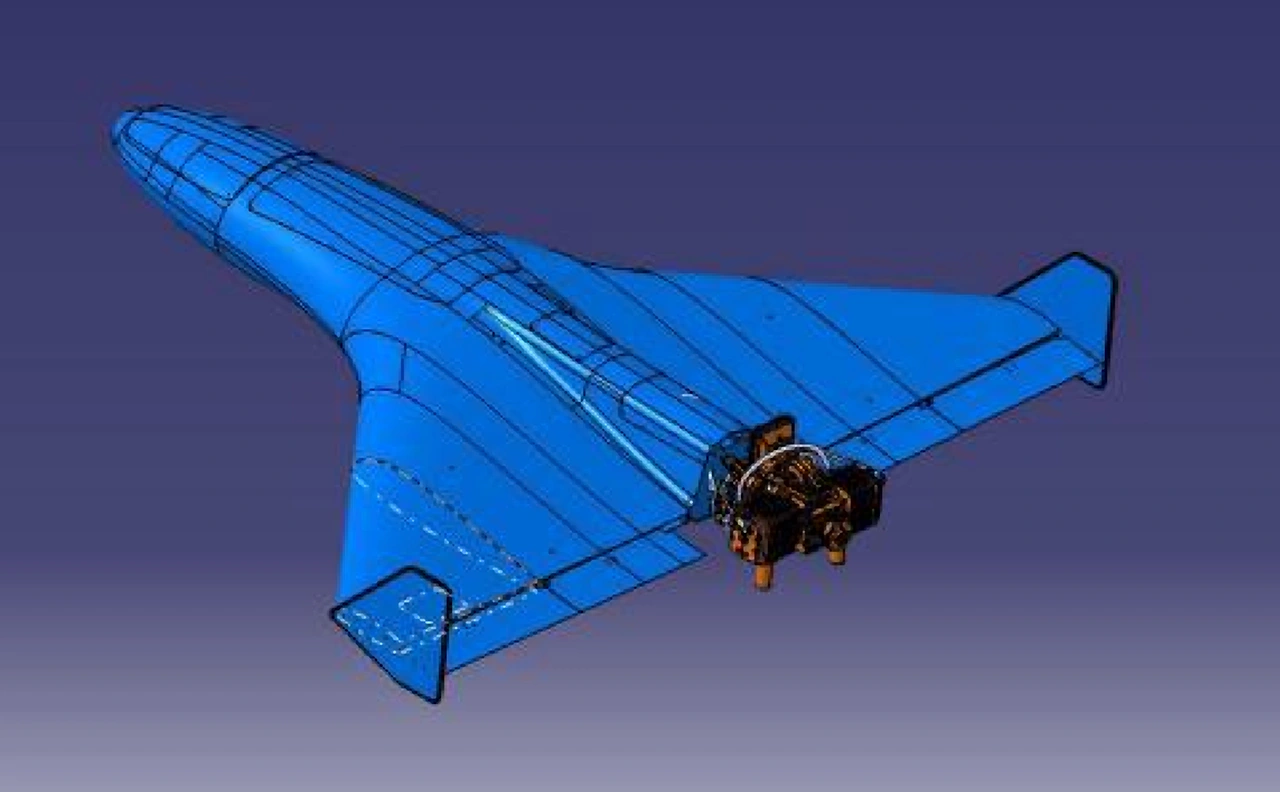
HY2600 Delta Wing UAV: Design, Specifications and One-Way Strike Mission Profile
How the HY2600 delta wing one-way strike UAV works: 2,000 km range, 50 kg payload, rocket-boost launch, no recovery mode and the systems inside the airframe.
November 10, 2026
What is the HY2600?
The HY2600 is a tailless delta wing unmanned aircraft built for long-range strike missions against ground targets. It carries a 50 kg payload over a maximum range of 2,000 kilometres, cruises at 180–220 km/h, and reaches a maximum level flight speed of 320 km/h.
What sets the HY2600 apart in a crowded market is not a single headline number. It is the combination of three things operators consistently ask for: a long-range airframe that fits standard transport and storage, two independent launch modes so you can deploy from prepared sites or field positions, and a parachute recovery configuration that returns the aircraft instead of writing it off. That last point changes the economics. A platform that comes back can be flown again, tested, and reconfigured — the airframe stops being a single-use consumable and starts becoming an asset on the order book.
Two launch modes: pneumatic vehicle or rocket launcher
Launch configuration is a deployment decision, not a fixed specification. The HY2600 supports two launch modes, and which one you use depends on the site and the mission.
Pneumatic launch vehicle. The aircraft is launched from a pneumatic launch vehicle, which brings the platform to field positions without heavy ground infrastructure. Where roads, tracks and prepared areas are limited, this mode gets the aircraft airborne from a much smaller footprint than a fixed launch stand.
Rocket launcher. For prepared positions, the rocket launcher delivers a higher and more consistent initial energy. The launch subsystem consists of the launch frame and the booster rocket, with front and rear adjustment arms setting launch attitude for the intended profile. The booster rocket and launch frame are quoted separately from the aircraft, so either mode can be specified to fit an existing deployment plan.
The published mission profile resolves into three phases: launch; climb to a 1 km cruise altitude and 2,000 km of cruise at 220 km/h, the upper end of the cruise band; then entry onto the attack route. On the terminal mission the aircraft completes the strike. On training, evaluation and non-terminal missions, the parachute recovery configuration returns it.
Parachute recovery and what it changes for operators
This is the configuration that changes how the aircraft is bought and used. A parachute recovery option brings the HY2600 back after non-terminal flights, reliably enough that operators build it into the standard deployment pattern rather than treating it as an exception. The same airframe can then be launched repeatedly across a training cycle, a demonstration schedule, or a series of evaluation flights before it is ever committed to a terminal mission.
Operationally, that removes three of the cost arguments that normally sit against platforms in this class. Crews train on the real aircraft rather than on a surrogate. Maintenance teams inspect the actual returned airframe instead of writing the unit off. Demonstration and evaluation flights stop consuming airframes. For procurement teams modelling fleet cost over a multi-year cycle, this is often the line item that decides between otherwise comparable platforms.
Why a tailless delta wing?
From above, the HY2600's low-aspect-ratio delta wing dominates. The aircraft is still longer than it is wide: 2.85 m from nose to rear against a 2.5 m wingspan, with 1.725 m² of wing area — an aspect ratio of roughly 3.6.
From the side, most of that surface disappears. Overall height is 0.42 m, and there is no horizontal tailplane where a conventional light aircraft would carry one. The engine drives a propeller at the opposite end from the nose, in a pusher arrangement that gives strong wind resistance and insensitivity to angle-of-attack changes caused by gusts.
That geometry is not styling. The low-aspect-ratio tailless delta configuration delivers higher flight speed and better fuel efficiency than airframes of comparable specification, the larger wing surface supports a higher load capacity, and the structurally simple planform shortens the production cycle and reduces cost. Service ceiling is 6,000 m and wind resistance is rated at level 6.
HY2600 specifications
Maximum takeoff weight is 260 kg against an empty weight of 100 kg, leaving 50 kg of payload. Cruise speed is 180–220 km/h and maximum level flight speed is 320 km/h. Service ceiling is 6,000 m, wind resistance is rated at level 6, and maximum range is 2,000 km.
Range and payload are separate figures. Carrying the full 50 kg across the complete 2,000 km would require evidence for that specific configuration, and configuration-dependent performance is confirmed against a mission-specific data sheet. Where you need a firm performance envelope for a defined profile, we provide it.
Systems, payloads and options
The power subsystem covers engine, propeller, ignition and starting, fuel supply, control mechanism, monitoring and power generation. The fuel subsystem adds ground refuelling and defuelling, tank ventilation and fuel measurement — ground refuelling determines turnaround time between launches.
The flight-management subsystem comprises the flight control and management computer, sensors, servo actuation, the link and a signal acquisition box. The flight control computer is single-redundancy, combining a simple atmospheric system, MEMS inertial navigation and satellite positioning. The link is a one-station, multi-aircraft arrangement, so one ground position can direct several aircraft.
Guidance is configurable to the mission. The nose can carry a photoelectric seeker with visible and infrared channels for image matching against libraries of bunkers, ships, armoured vehicles and buildings, or a laser, infrared or radar-guided warhead. For contested electromagnetic environments, a low-profile anti-jam antenna with four GPS L1/BDS B1 elements is available, supported by anti-interference equipment, fibre-optic inertial navigation and autonomous visual navigation for stable flight in denied environments. Optional RDSS satellite communication provides beyond-visual-range control with no relay aircraft in the chain.
Ground support and delivery
The ground control station is portable and can be upgraded to a shelter-type station: a three-screen portable station, AC220 to DC24V power supply, data link ground terminal and antenna, cables and a tripod. Launch equipment is supplied per the mode you select.
Why operators choose Stroni
The HY2600 is one platform in a wider Stroni range that also covers the HY180 delta wing UAV, the turbojet HY2400 and the full defense and tactical UAV portfolio. Buyers who need one platform plus a counter-drone package, or a fixed-wing and rotary pairing, source from a single supplier.
The platform is in operational service with defence and security operators in multiple regions. What that means in practice is a support network that answers: 24/7 technical support with immediate response, remote diagnosis and on-site service, response within 48 hours in major cities, and comprehensive training and maintenance manuals so your own team can maintain the fleet and hold down lifecycle cost. The airframe is modular, and payload integration, custom modifications and pilot-batch delivery are handled in-house.
International B2B orders are supported on FOB and CIF terms, with training and support packages scoped to your operating environment.
For the HY2600 specifically, our engineering team works through launch mode selection, booster and frame configuration, guidance and seeker choice against the target type, and the ground support footprint needed at the operating position. Contact our team with your mission parameters and we will map them to a configuration and quotation. Technical specifications and project information: info@stroniuav.com.
About the Author:Wei Chen is the Chief UAV Engineer at Stroni, focusing on the architectural design and flight control system optimization of industrial multi-rotor platforms. Learn more →
Frequently Asked Questions
What is the range of the HY2600 UAV?
+
2,000 km, with cruise at 180–220 km/h and maximum level flight speed of 320 km/h.
How much payload can the HY2600 carry?
+
50 kg, against a 260 kg maximum takeoff weight and 100 kg empty weight.
Does the HY2600 have a tail or horizontal stabilizer?
+
No. It uses a tailless delta wing, with control provided by wing-mounted actuators rather than separate tail surfaces.
Is the HY2600 recoverable after a strike mission?
+
No. Recovery mode is specified as no recovery. Where a recoverable airframe is required, a reusable platform such as the HY180 is the relevant class.
Continue Exploring
Continue Exploring
Keep the momentum going with a few related reads selected to extend this topic into strategy, deployment, and practical field use.
Featured Read
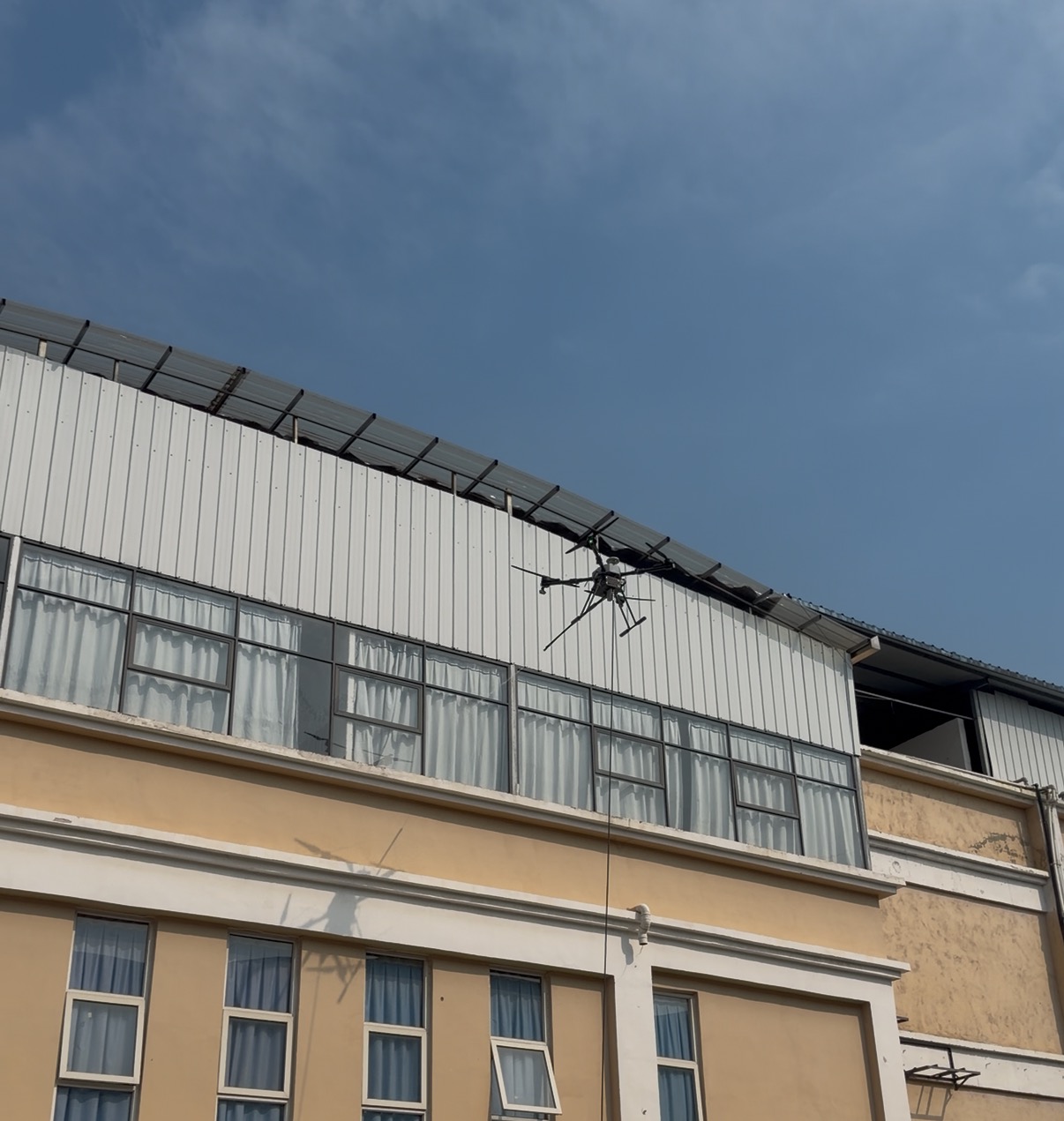
How Stroni UAV Is Rethinking Automated Drone Cleaning
Cleaning Drone · Sep 14, 2026
Recommended
How Much Does an Agricultural Spraying Drone Cost in 2026? Complete Price Guide
Agriculture Drones · Jul 3, 2026
Recommended
Agriculture Drone Payloads Explained: Spraying, Spreading, Mapping and Multispectral Imaging
Agriculture Drones · Jul 31, 2026
Recommended
How Agricultural Spraying Drones Work: From Route Planning to Droplet Deposition
Agriculture Drones · Jul 31, 2026
Recommended
Agriculture Drones in China: Technology, Applications and Operating Principles
Agriculture Drones · Jul 31, 2026
Want more industry insights?
Explore drone applications, implementation playbooks, and operational best practices with our editorial team.